
What Is Angular Momentum?
Angular momentum (L) is the rotational counterpart of linear momentum. It measures the quantity of rotational or orbital motion an object possesses, taking into account both its angular velocity and how its mass is distributed about the axis or point of rotation. The larger angular momentum is, the larger the net external torque required to change the speed or direction of that rotation in a given time.
Everyday Examples
Everyday examples of angular momentum include
- An ice skater spinning with her arms outstretched, then pulling her arms in and spinning much faster
- A child on a playground merry-go-round
- A bicycle wheel that keeps spinning after you let go of the pedals
- A planet revolving about the Sun
In every case the object has angular momentum.
Furthermore, angular momentum gets larger when
- The object is moving faster in its rotation or orbit.
- The mass of the object is farther from the axis of rotation (e.g., arms outstretched, larger orbit).
In addition, angular momentum has a direction. By the right-hand rule, if the fingers of your right hand curl in the direction of the rotation, your thumb points in the direction of the angular momentum vector (L).
What Is Angular Momentum for a Classical Particle?
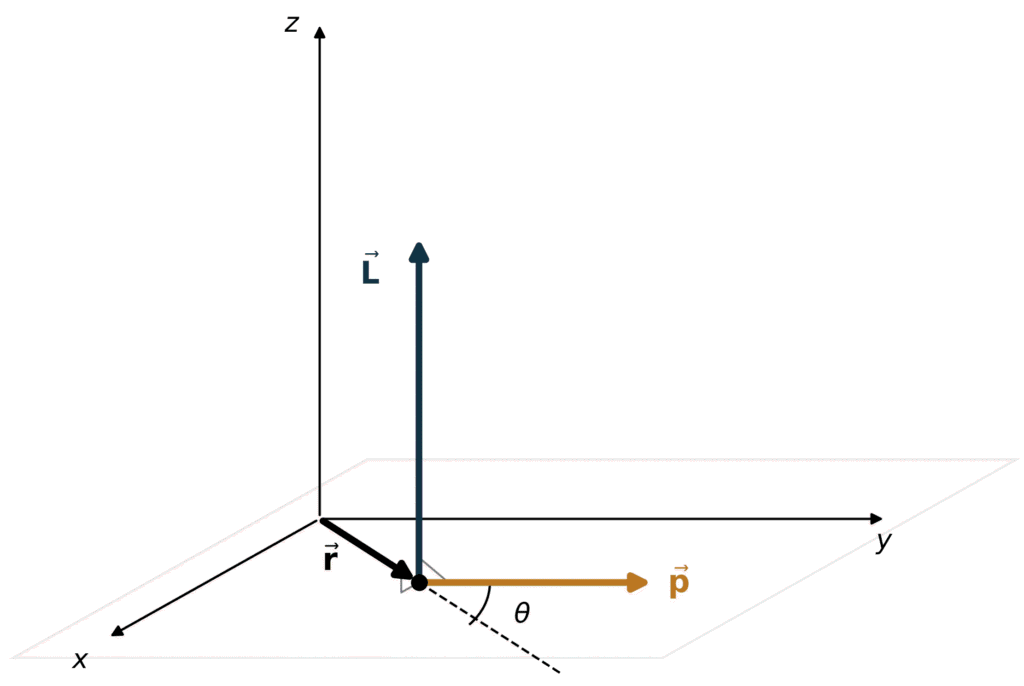
Consider a classical particle revolving in the xy plane around the origin of three-dimensional space and having linear momentum p. The vector r is the arrow that you draw from the origin to the particle’s current location. It is the particle’s position relative to the origin. The vector v is the particle’s velocity at that same instant. The cross product of r and p gives L for the particle:
L = r x p = r x mv
Curl the fingers of your right hand in the direction of the revolving motion of the particle; your thumb will point in the direction of L. As you can see in the following figure, L sticks straight out of the plane formed by r and p and is perpendicular to r and p.
Moreover, the magnitude of L is
L = rpsinθ
where θ is the angle between r and p.
What Is Angular Momentum for a Rigid Body?
For a rigid body rotating about a fixed axis, we often use the simpler form
L = Iω
where I is the moment of inertia about that axis and ω is the angular velocity.
The Law of Conservation of Angular Momentum
When the net external torque on a system is zero, the total angular momentum of the system does not change. This rule is the law of conservation of angular momentum. (External forces may act on the system as long as they produce no net torque.)
For example, when an ice skater pulls her arms in, her moment of inertia decreases. Since no other major force is acting on her, her angular momentum is conserved; thus, her angular (rotational) velocity increases. She has increased her rotational speed by redistributing her mass around her axis of rotation.
The law of conservation of angular momentum is the same in the macroscopic, microscopic, and submicroscopic worlds, but the origin of that momentum is different: Macroscopic objects derive it from motion, but submicroscopic particles (e.g., electrons) have it as an intrinsic property.