
What Is Spin Angular Momentum?
In quantum mechanics, spin angular momentum (S) is a vector: It has both a length and a direction. However, due to quantum uncertainty, we can never know the exact direction that a quantum vector points. We can know only two things at once about S: its magnitude (S) and its component along one chosen axis, usually the z axis (Sz). S is an intrinsic property. It stays fixed for any given type of fundamental particle and is the reason unpaired electrons behave like tiny magnets.
The Magnitude of Spin Angular Momentum Is Fixed
S is the total amount of spin angular momentum that a fundamental particle (e.g., an electron, a proton) possesses:
S = √s(s+1)ℏ
Here s is the total spin quantum number, and ℏ is the reduced Planck’s constant (6.626 x 10⁻³⁴ m2kg/s ÷ 2π). Each type of fundamental particle has a fixed value for s. For an electron, s = ½. Thus, S ≈ 0.8660ℏ, which is 9.1331 x 10⁻³⁵ Js. Hence, for a given type of fundamental particle, S is fixed: It can never increase or decrease.
The Spin Magnetic Quantum Number Focuses on One Projection of the Vector
When we measure the z-component of spin angular momentum, the result is
Sz = msℏ
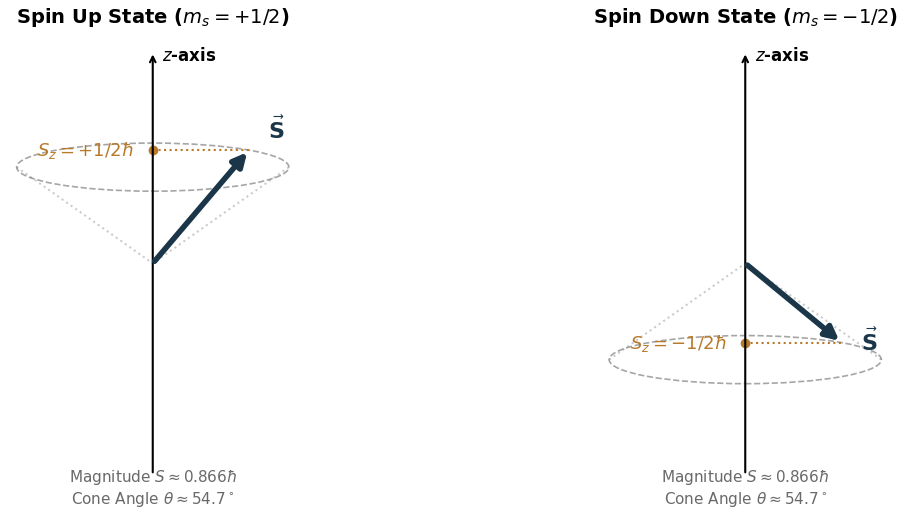
The spin magnetic quantum number (ms) equals ±½ for an electron. ms tells us the length of the projection of the spin angular momentum vector on the chosen axis (usually the z axis) and whether that projection is pointing towards the positive end of the axis or towards the negative end of the axis.
We can measure the exact direction that a classical vector points. In other words, we can know the x, y, and z components at the same time. In contrast, quantum uncertainty prevents us from measuring the exact direction that a quantum vector points. ms is the closest that quantum mechanics allows us to get to defining the orientation of the spin angular momentum vector of a fundamental particle. Orientation means the direction that the vector points relative to our measurement axis, which is usually the z axis: Does the vector point towards the positive end of the axis or towards the negative end of the axis?
The projection of a vector along a single chosen axis is a scalar, not a vector. (Thus, Sz = msℏ is a scalar.) Therefore, the projection lacks a full spatial direction. It does, however, have a magnitude and a sign (positive or negative). We are looking at only one dimension (the chosen axis). Therefore, the sign acts as a substitute for direction. The plus or minus sign tells us whether the projection points in the positive or the negative direction of the axis. For an electron, the absolute value of the projection of S along the chosen axis is always ½ℏ.
The Spin Angular Momentum Vector Forms a Cone
Picture the measurement axis as a vertical pole (the z axis). The length of S (≈0.8660ℏ) is longer than its vertical projection (0.5ℏ). Therefore, the spin angular momentum vector cannot point straight up or straight down along that pole, nor can it lie parallel to it. The vector must tilt away from the pole and form a cone around it. The entire tilt comes from the Sx and Sy components of S.
A concrete analogy helps. Think of a spinning top that leans and traces a circle as it precesses. The spin angular momentum vector behaves in a similar way: It is forced to tilt and can be pictured as sweeping around the measurement axis.
Scientists visualize the two possible values of ms with tiny arrows:
- An upward arrow (↑) stands for ms = +½ (spin up). In this case, the projection of the spin angular momentum vector on the z axis points towards the positive end of the axis.
- A downward arrow (↓) stands for ms = –½ (spin down). In this case, the projection of the spin angular momentum vector on the z axis points towards the negative end of the axis.
Spin Angular Momentum Makes an Electron a Magnet
An electron’s spin angular momentum turns the electron into a submicroscopic magnet: Thus, an electron has a north pole and south pole. An electron has a negative charge. Consequently, the direction of its magnetic dipole moment is opposite the direction of its spin angular momentum.
The Net Magnetic Effect of Paired Electrons Is Zero
When two electrons occupy the same orbital, the Pauli exclusion principle requires one to have ms = +½ and the other to have ms = –½. Their z-components of spin angular momentum, therefore, point in opposite directions. As a result, their magnetic dipole moments also point in opposite directions and cancel each other. Hence, the net magnetic effect of that pair is zero.
In summary, spin angular momentum is an intrinsic vector property of fundamental particles, including electrons. Its magnitude is fixed, yet quantum uncertainty limits us to knowing only one component at a time. This property makes unpaired electrons tiny magnets whose effects cancel when the electrons pair.