Magnetic Dipole Moment
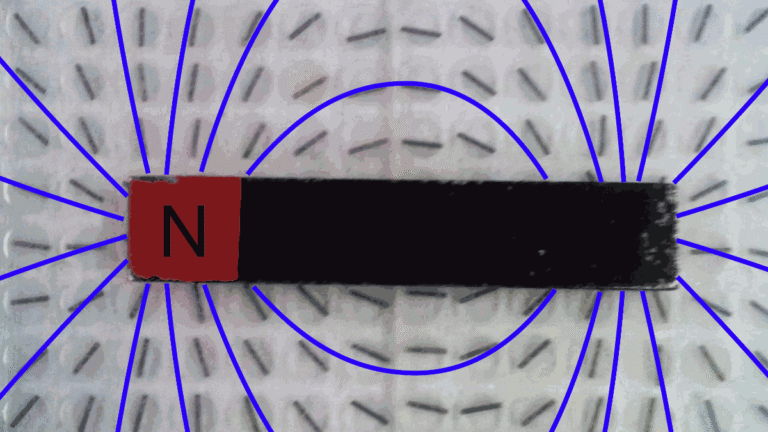
A magnetic dipole moment (μ) measures the strength and orientation of a magnetic dipole (e.g., a bar magnet, a loop of electricity). Imagine a tiny, circular racetrack where electrical current is constantly zooming around in a loop. This swirling electricity creates a miniature north and south pole, acting exactly like a microscopic compass needle.
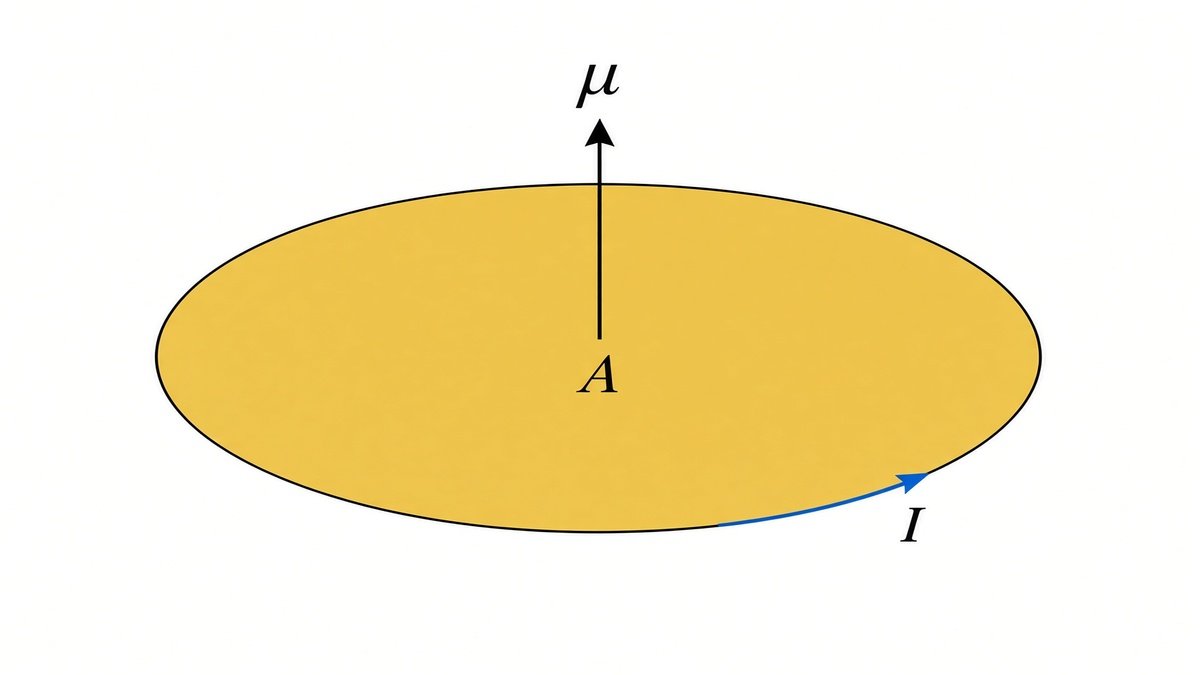
The magnetic dipole moment of a simple wire loop is calculated by multiplying the current by the area vector:
μ = IA
where
I is a scalar, the electrical current flowing through the wire.
A is a vector, the area vector, whose magnitude is the surface area of the loop and whose direction points perpendicular to the loop.
A magnetic dipole moment determines how much torque (twisting force) a magnet will experience in an external magnetic field (B). We must use a cross product to find out how μ twists when placed in B.