
Why Can Iron, Cobalt, and Nickel Be Ferromagnetic?
Magnetism is a physical phenomenon that happens when materials exert attractive or repulsive forces on other materials. Electron spins and the motion of electric charges cause these forces. Magnetism is the broad category for all types of magnetic behavior. Ferromagnetism is one of those types. A ferromagnetic material attracts strongly to magnets. You can magnetize it easily to form a permanent or temporary magnet. The question is why? To answer this question, we will examine why iron, cobalt, and nickel can be ferromagnetic. Three criteria must be met:
First, Iron, Cobalt, and Nickel Can Be Ferromagnetic Because They Have Unpaired 3d Electrons
Electron Configurations of the Three Metals
These three metals belong to the 3d transition metal series. They all have unpaired electrons in their ground-state electron configurations. The unpaired electrons reside in the 3d subshells and are partly responsible for the ferromagnetism of iron, cobalt, and nickel.
Unpaired 3d Electrons Create a Magnetic Dipole Moment
Every electron has an intrinsic quantum property called spin. This property causes an electron to act like a submicroscopic bar magnet with a north pole and a south pole. When electrons pair in an orbital, they point in opposite directions (spin-up and spin-down) and cancel their magnetic fields completely thereby.
Because these three metals have unpaired (3d) electrons, their spins do not cancel out. Consequently, each iron, cobalt, and nickel atom has a permanent, net magnetic dipole moment, effectively transforming each atom into a tiny magnet.
Second, Iron, Cobalt, and Nickel Can Be Ferromagnetic Because the Distance Between Neighboring Atoms Matches the Radius of Their 3d Orbitals
Having unpaired 3d electrons and thus magnetic atoms is not enough on its own for a material to be ferromagnetic. Next, a powerful electrostatic interaction called exchange interaction must be present. Let us see how: In these three solids, the distance between neighboring atoms matches the radius of their 3d orbitals.1,2 As an analogy, imagine a crowded room in which people want to hold hands, but they can only do so comfortably if they are standing at the perfect distance from each other. If they stand too far apart, they cannot touch each other. If they crowd too close together, they bump elbows and get pushed out of sync.
Happily, in these metals, the atoms in the metal grid are standing at that sweet spot: The distance between the atoms is just right—not too close and not too far away. Consequently, the 3d electron clouds of neighboring atoms can overlap gently and perfectly. This match of interatomic distance and 3d orbital radius is partly why iron, cobalt, and nickel can be ferromagnetic.
This overlap allows exchange interaction to step in and force all the atomic magnets—not just the electron magnets—to snap into perfect, parallel alignment, pointing in the same direction. Exchange interaction locks millions of these atomic magnets parallel: Their north poles point in the same direction. (The magnetic field of each atom is the sum of the magnetic fields of its 3d unpaired electrons.) As a result, these atomic magnetic fields add together. Different atomic spacing would prevent this atomic “handshake,” and iron, cobalt, and nickel could not be ferromagnetic.
Third, Iron, Cobalt, and Nickel Can Be Ferromagnetic Because Their Atoms Form Magnetic Domains That Align with an External Magnetic Field
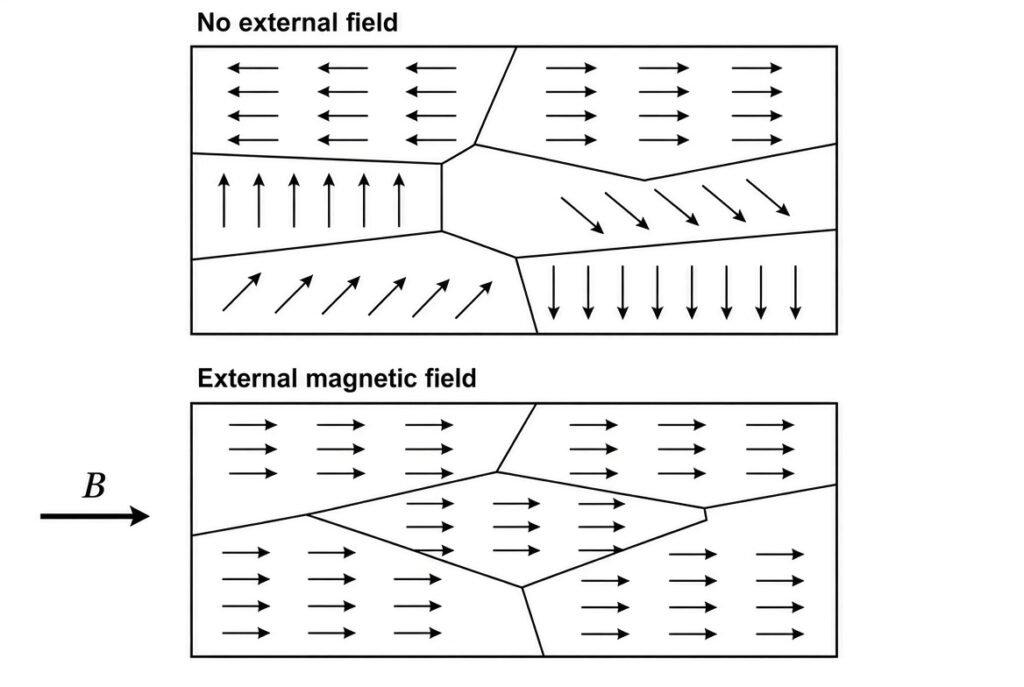
Because of exchange interaction, millions of neighboring atomic magnets align in the same direction, grouping together into microscopic regions called magnetic domains. Unfortunately, just the formation of those domains is not enough for iron, cobalt, and nickel to become ferromagnetic. For in the absence of an external magnetic field, these domains point in random directions, canceling each other out globally, so the bulk metal does not act like a magnet.
In contrast, in the presence of an external magnetic field, magnetic domains pointing in the direction of the field grow rapidly and consume the others. The exchange interaction locks them tightly in place. Thus, many of these domains stay aligned even after the external magnetic field is removed, turning iron, cobalt, and nickel into a permanent magnet.
In conclusion, iron, cobalt, and nickel can be ferromagnetic if the following conditions are met: They have unpaired 3d electrons, which give their atoms a magnetic moment. The distance between neighboring atoms matches the radius of their 3d orbitals. Their magnetic domains form and then align with an external magnetic field.3
- An orbital is a three-dimensional region of space. The radius of an orbital is the distance from the nucleus out to where the electron density becomes small. ↩︎
- The 3d electron shells are the active magnetic layer of each atom. Even though a filled 4s electron shell wraps around the very outside of the atom, it is dead magnetically. ↩︎
- “Can be” implies that these metals are not always ferromagnetic. Indeed, that is the case. Below the Curie temperature of each metal, the magnetic domains stay aligned even after one removes the external field, turning iron, cobalt, and nickel into a permanent magnet. However, above the Curie temperature of each metal, the magnetic domains no longer align, and the metals become paramagnetic. ↩︎